 Spendsplained
Anchoring: Why “Was $200, Now $99” Works on Almost Everyone
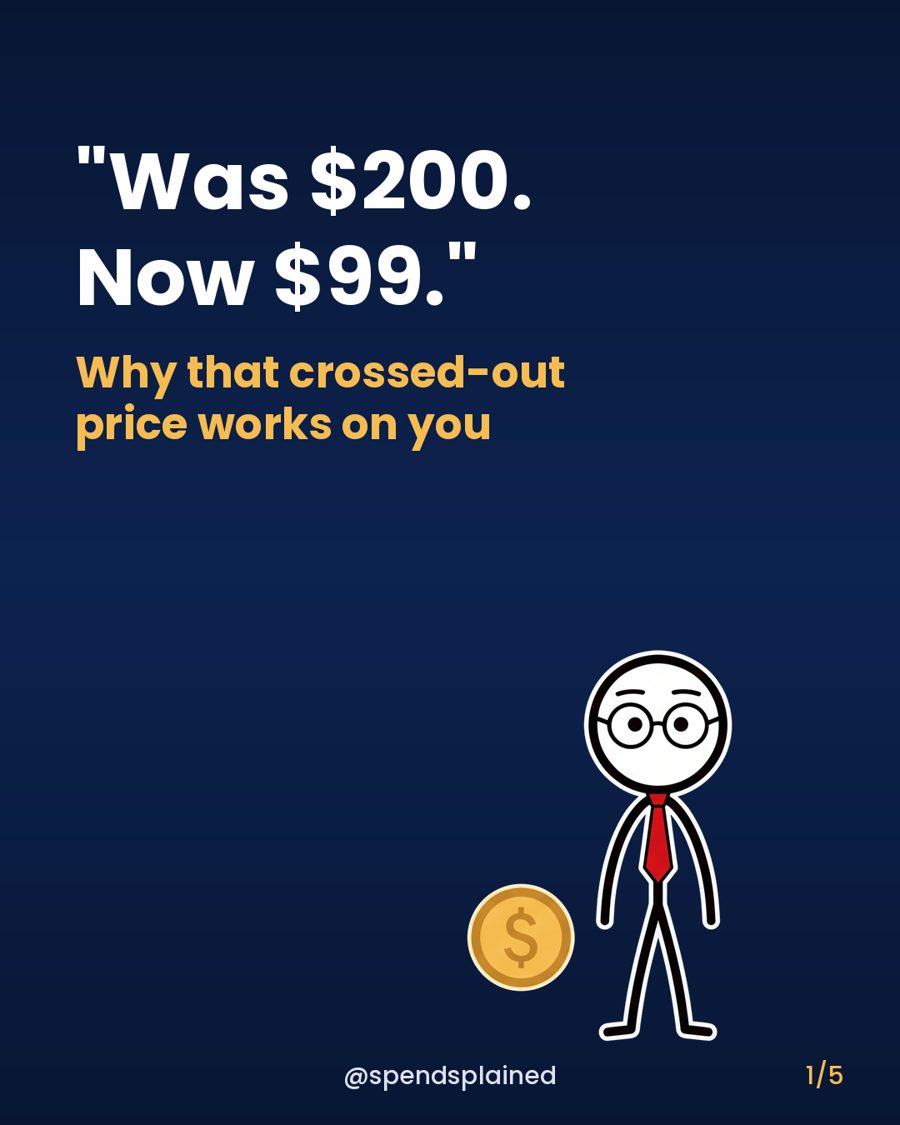
You walk past a shop window. A jacket has a price tag with one number crossed out — $200 — and a new one beside it: $99. Your brain does a little happy dance. Half price! You might not even need a jacket.
Here’s the uncomfortable question: how do you know the jacket was ever worth $200? Usually, you don’t. But that first number has already done its job. Psychologists call it an anchor.
A spinning wheel and the United Nations
The classic demonstration comes from Amos Tversky and Daniel Kahneman. In their famous 1974 paper in Science, they described an experiment in which a wheel of fortune, rigged to stop at either 10 or 65, was spun in front of participants. People were then asked whether the percentage of African countries in the United Nations was higher or lower than that number, and then to give their own estimate.
The wheel was obviously random. Yet it pulled people’s answers: the median estimate was 25% for those who saw 10, and 45% for those who saw 65. A number everyone knew was meaningless still shaped a serious judgement.
Tversky and Kahneman described this as “anchoring and adjustment”: we start from whatever number is in front of us and adjust away from it — but usually not far enough.
Even random numbers set your price
Does this work with real money? Dan Ariely, George Loewenstein and Drazen Prelec tested it in a study published in 2003. They asked MBA students to write down the last two digits of their social security number and say whether they would pay that many dollars for items such as wine, a cordless keyboard and chocolates. Then the students stated the maximum they’d pay, knowing that their answers could actually lead to a purchase.
Students with higher digits consistently offered more. Those in the top fifth of social security numbers typically offered around three times as much as those in the bottom fifth — about $56 versus $16, on average, for a cordless keyboard. The researchers also noticed something subtle: people’s valuations were internally consistent (they still valued the better wine more than the cheaper one), but the overall level was arbitrary. They called this “coherent arbitrariness”.
The anchor doesn’t tell you what’s better. It tells you how big the numbers should feel.
“But experts wouldn’t fall for it”
Unfortunately, they do. In 1987 Gregory Northcraft and Margaret Neale gave real estate agents and students a tour of an actual house along with a property information pack. The only difference between groups was the listing price in the pack. The agents’ estimates of the home’s value moved in the direction of the listing price they were given — and many agents said the listing price hadn’t influenced them.
Later work by Birte Englich, Thomas Mussweiler and Fritz Strack went further. In one of their studies, experienced legal professionals read a shoplifting case and then rolled a pair of dice — secretly loaded to total either 3 or 9 — to set the prosecutor’s sentencing demand in months. Those who rolled 9 gave noticeably longer sentences on average than those who rolled 3. Expertise reduces many mistakes; it doesn’t seem to switch off anchoring.
Reference prices: the anchor you carry around
In shopping, the most important anchor is often a reference price — the number in your head for what something “should” cost. Richard Thaler illustrated this with a now-famous scenario: you’re lying on a hot beach and a friend offers to buy you a cold beer. How much are you willing to pay? The median answer in his survey was $2.65 if the beer came from a fancy resort hotel, but only $1.50 if it came from a small run-down grocery store — even though the beer, and the beach, were identical.
The reason is what Thaler called “transaction utility”: we enjoy (or hate) the deal itself, compared with what we expected to pay. A high reference price makes a deal feel great; a low one makes the same price feel like a rip-off.
Where businesses place anchors
Once you know the trick, you’ll spot anchors everywhere:
- Strikethrough prices. “Was / now” tags set a high reference price, so the real price feels like a gain.
- The expensive item at the top of the menu. A very pricey dish makes the next one down look reasonable.
- “Recommended retail price.” A number printed on the box that the shop never intends to charge.
- Pricing pages. Showing the premium plan first makes the mid-tier plan feel modest.
- Negotiations. Research by Adam Galinsky and Thomas Mussweiler found that first offers strongly predicted final settlement prices in negotiation exercises — whoever made the first offer tended to get a better outcome, unless the other side deliberately focused on information that contradicted that offer.
How to un-anchor yourself
You can’t delete an anchor from your brain, but you can add better ones:
- Decide your number before you look. Before browsing, write down what you’d be happy to pay. That becomes your anchor instead of theirs.
- Check the real price history. For online shopping, price-tracking tools can show whether “was $200” was ever true.
- Ask “would I buy it at this price with no discount?” If the answer is no, the discount is doing the selling.
- Consider the opposite. Thomas Mussweiler, Fritz Strack and Tim Pfeiffer found that deliberately listing reasons why an anchor might be inappropriate reduced its pull.
- In negotiations, go first when you’re well-informed. If you know the market, a confident, reasonable first number can work for you.
The quiet power of the first number
Anchoring isn’t a sign of stupidity. It’s a shortcut that usually helps: when we genuinely don’t know what something is worth, using the nearest available number is often a decent guess. The problem is that in shops, menus and negotiations, someone else gets to choose that number.
So next time you see a price crossed out, smile at it like an old friend. Then ask the stickman question: “Says who?”
Sources
- Tversky, A. & Kahneman, D. (1974). “Judgment under Uncertainty: Heuristics and Biases.” Science, 185(4157), 1124–1131. doi:10.1126/science.185.4157.1124
- Ariely, D., Loewenstein, G. & Prelec, D. (2003). “‘Coherent Arbitrariness’: Stable Demand Curves Without Stable Preferences.” Quarterly Journal of Economics, 118(1), 73–105. doi:10.1162/00335530360535153
- Northcraft, G. B. & Neale, M. A. (1987). “Experts, Amateurs, and Real Estate: An Anchoring-and-Adjustment Perspective on Property Pricing Decisions.” Organizational Behavior and Human Decision Processes, 39(1), 84–97. doi:10.1016/0749-5978(87)90046-X
- Englich, B., Mussweiler, T. & Strack, F. (2006). “Playing Dice with Criminal Sentences: The Influence of Irrelevant Anchors on Experts’ Judicial Decision Making.” Personality and Social Psychology Bulletin, 32(2), 188–200. doi:10.1177/0146167205282152
- Thaler, R. (1985). “Mental Accounting and Consumer Choice.” Marketing Science, 4(3), 199–214. doi:10.1287/mksc.4.3.199
- Mussweiler, T., Strack, F. & Pfeiffer, T. (2000). “Overcoming the Inevitable Anchoring Effect: Considering the Opposite Compensates for Selective Accessibility.” Personality and Social Psychology Bulletin, 26(9), 1142–1150. doi:10.1177/01461672002611010
- Galinsky, A. D. & Mussweiler, T. (2001). “First Offers as Anchors: The Role of Perspective-Taking and Negotiator Focus.” Journal of Personality and Social Psychology, 81(4), 657–669. doi:10.1037/0022-3514.81.4.657