 Spendsplained
The Pain of Paying: Why Tapping a Card Feels Easier Than Handing Over Cash
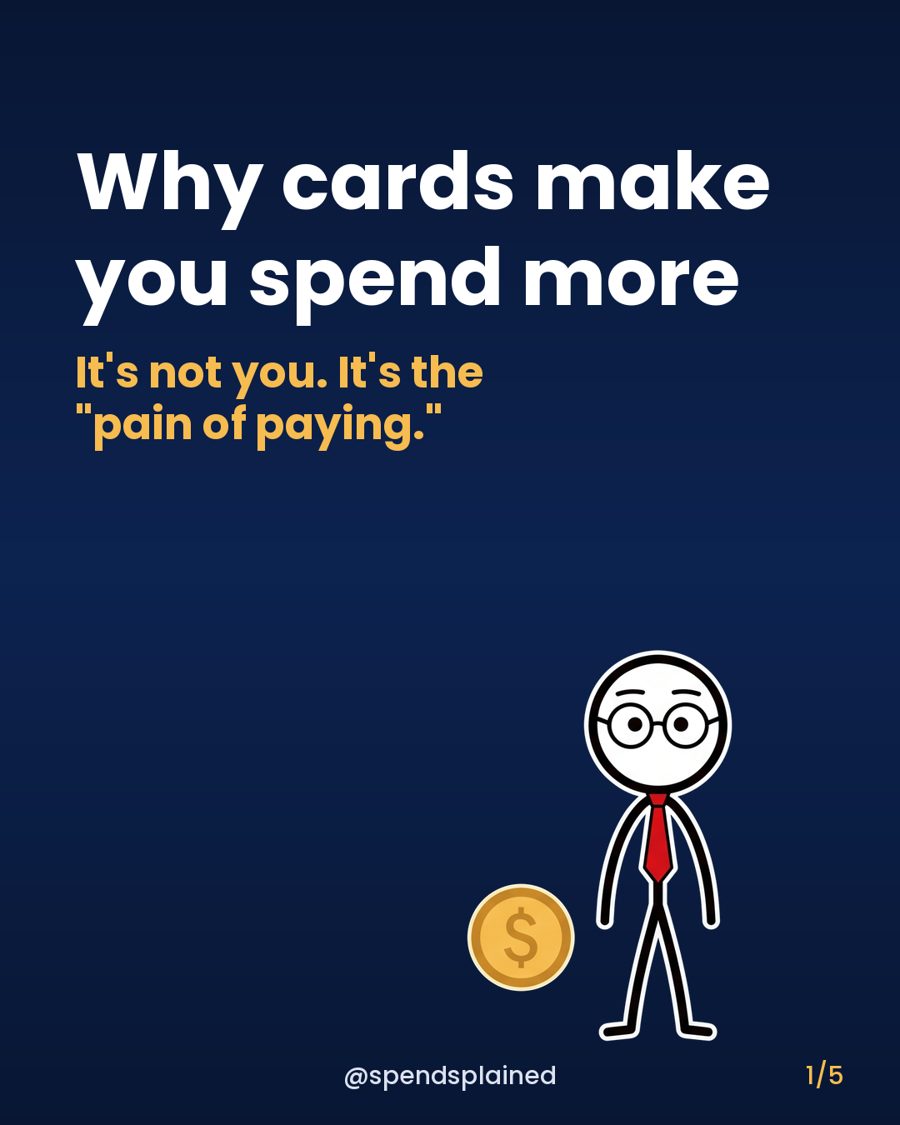
Think about the last time you paid for something with a stack of physical notes. You probably counted them, watched them leave your hand, and felt a tiny pinch. Now think about the last time you tapped a phone against a card reader. Beep. Done. Barely a feeling at all.
That pinch has a name in behavioural economics: the pain of paying. And understanding it might be one of the most useful money ideas you’ll ever learn — partly because companies understood it long before most of us did.
Paying is not emotionally neutral
Classical economics treats money as money: a dollar is a dollar however you hand it over. But in 1998 the economists Drazen Prelec and George Loewenstein proposed something more human. In their paper “The Red and the Black”, they argued that people feel an immediate, unpleasant sensation when they pay — a kind of emotional cost on top of the price itself. That discomfort, they suggested, acts as a natural brake on spending.
Their model also explains why we prefer some payment arrangements to others. When payment and enjoyment are tightly linked — say, a taxi meter ticking in front of you — every second of the ride feels expensive. When payment is “decoupled” from what you’re enjoying, such as an all-inclusive holiday paid months earlier, you can relax and enjoy it. Same money, very different feeling.
You can see it in the brain
In 2007 a team led by Brian Knutson at Stanford, together with Prelec, Loewenstein and colleagues, put people in a brain scanner while they decided whether to buy real products. Liking a product was linked to activity in a reward-related area (the nucleus accumbens). Prices that felt too high were linked to activity in the insula — a region associated with, among other things, anticipating losses and unpleasant feelings — and to reduced activity in part of the prefrontal cortex. Activity in each of these regions helped predict whether the person went on to buy, beyond what their own ratings predicted.
It’s important not to over-read a single study: brain imaging doesn’t show a literal “pain button”. But the finding fits the idea neatly. Buying looks like a tug-of-war between “I want it” and “ouch, the price”.
Why cards and phones numb the pinch
If paying hurts, anything that makes payment less visible should reduce the hurt — and potentially increase spending. That is exactly what Prelec and Duncan Simester tested in a study published in 2001. They ran real sealed-bid auctions for things like basketball and baseball tickets, with one twist: some participants were told they would have to pay by credit card, others in cash.
People told to pay by card bid substantially more for the same prizes — for the Celtics tickets, the average card bid was more than double the cash bid. Nothing about the tickets changed. Only the way the money would leave. The authors are careful to add that the effect isn’t universal: in a second study, using a restaurant gift certificate with a clearly known value, the card premium only appeared in one condition.
Today, the same logic applies to stored cards, one-click checkouts, in-app purchases and “buy now, pay later” buttons. Each one removes a moment where you might notice the cost. That isn’t necessarily evil — convenience is genuinely valuable — but it does mean the natural brake works less well.
Our stickman’s rule of thumb: the smoother the payment, the more deliberately you should think about the price.
Subscriptions: the pain arrives once, the use doesn’t
John Gourville and Dilip Soman studied what happens when payment and use are separated in time. In a series of experiments they found that the felt cost of a prepayment fades as time passes — they called this “payment depreciation”. In a later Harvard Business Review article they described data from a health club: members who paid annually, semi-annually or quarterly used the club most right after each payment, with use tailing off until the next bill, while members who paid monthly used it more steadily.
From a business perspective, that’s a fascinating lesson. A big upfront payment hurts once, then quickly feels “spent”. Smaller, regular payments keep the cost — and the reason you signed up — fresh in your mind. That’s also why monthly subscriptions you rarely use can survive for years: the payment is so small and automatic that it never triggers enough pain to make you cancel.
Tightwads, spendthrifts, and everyone in between
Not everyone feels the pinch equally. Scott Rick, Cynthia Cryder and George Loewenstein developed a short “Spendthrift–Tightwad” scale and collected responses from more than 13,000 people. Tightwads report feeling intense pain when paying and often spend less than they’d ideally like to — even on things that would make them happier. Spendthrifts feel little pain and tend to spend more than they’d ideally like. Overall, tightwads outnumbered spendthrifts by about 3 to 2 — although the authors note the balance depended on which group of people was surveyed, and in one sample spendthrifts were more common.
So the goal isn’t “maximum pain”. A little discomfort protects you from impulse buys; too much can stop you enjoying the money you’ve worked for. The aim is the right amount of pain, in the right places.
How to use the pain of paying on purpose
Here are some practical ideas, all based on the mechanics above rather than any magic formula:
- Add friction where you overspend. Remove saved cards from the shops you browse late at night. Having to type sixteen digits is a surprisingly effective speed bump.
- Use cash (or a separate account) for “danger” categories. If takeaway food is your weak spot, give it its own visible budget. Watching it shrink brings the pinch back.
- Audit subscriptions every few months. List everything that renews automatically. For each one ask: “Would I sign up today at this price?”
- Translate prices into time. If you earn a certain amount per hour, convert a purchase into hours of work. It’s a quick way to make an abstract number feel real.
- Remove friction from what you value. If you’re a natural tightwad, pre-pay for things that genuinely improve your life — a class, a trip, a hobby — so you can enjoy them without the meter running.
The business story behind the beep
Once you see the pain of paying, you’ll notice it everywhere: casinos using chips instead of cash, theme parks with wristbands, hotels that charge everything “to your room”, apps that store your card “for next time”. Many of these designs make life easier. Some also make spending easier than it should be.
Richard Thaler’s work on mental accounting reminds us that we don’t treat all money the same way — we sort it into mental boxes and feel each transaction differently. The pain of paying is one of the strongest of those feelings. You don’t need to fight it, or eliminate it. Just notice it, and decide where you want it working for you.
That beep at the checkout? It’s quiet. But now you know what it’s quietly replacing.
Sources
- Prelec, D. & Loewenstein, G. (1998). “The Red and the Black: Mental Accounting of Savings and Debt.” Marketing Science, 17(1), 4–28. doi:10.1287/mksc.17.1.4
- Knutson, B., Rick, S., Wimmer, G. E., Prelec, D. & Loewenstein, G. (2007). “Neural Predictors of Purchases.” Neuron, 53(1), 147–156. doi:10.1016/j.neuron.2006.11.010
- Prelec, D. & Simester, D. (2001). “Always Leave Home Without It: A Further Investigation of the Credit-Card Effect on Willingness to Pay.” Marketing Letters, 12(1), 5–12. doi:10.1023/A:1008196717017
- Rick, S., Cryder, C. & Loewenstein, G. (2008). “Tightwads and Spendthrifts.” Journal of Consumer Research, 34(6), 767–782. doi:10.1086/523285
- Gourville, J. T. & Soman, D. (2002). “Pricing and the Psychology of Consumption.” Harvard Business Review, 80(9), 90–96. hbr.org
- Gourville, J. T. & Soman, D. (1998). “Payment Depreciation: The Behavioral Effects of Temporally Separating Payments from Consumption.” Journal of Consumer Research, 25(2), 160–174. doi:10.1086/209533
- Thaler, R. (1985). “Mental Accounting and Consumer Choice.” Marketing Science, 4(3), 199–214. doi:10.1287/mksc.4.3.199